Wednesday, December 14, 2011

What Happens When You Take Ron Paul Seriously?


I doubt he'll be either the nominee or even on the ticket (or in a Republican administration in any capacity), but it's worth taking a moment to talk about some of the aspects of Ron Paul's "philosophy." Here he is on Jon Stewart a few months ago discussing why a laissez faire regulation scheme would work better than a government enforced one:

"The regulations are much tougher in a free market, because you cannot commit fraud, you cannot steal, you cannot hurt people, and the failure has come that government wouldn't enforce this. In the Industrial Revolution there was a collusion and you could pollute and they got away with it. But in a true free market in a libertarian society you can't do that. You have to be responsible. So the regulations would be tougher."


To be as generous as possible to this idea, let's acknowledge the obvious: corporations love to manipulate the power of government to their own ends. That would seem natural and inescapable.

Let me at least point out one fairly obvious flaw in case it is not apparent. Paul religious faith in the market is such that he thinks the market would not sustain "fraud" or "stealing" from corporations. Yet one of the primary means these corporations engage in these practices is through the *avoidance* of regulations. Of course, some of those regulations might still be imposed upon small businesses, thus creating a disadvantage for these smaller businesses. In that circumstance, you have two choices: either create a better regulatory structure or remove regulations entirely.

There's probably a reason these corporations primarily fight first against any regulation at all.

Paul wants to pretend that absent government regulation, the incentive for these companies would be to play by the rules because the market would otherwise punish them. But let's say that you are a corporation and you want to make a lot of money doing something that your consumers would punish you for if they learned about it. So, one possible solution would be for them to not steal or commit fraud. That's Paul's point about the benefits of the free market.

Of course, that would mean wooing customers with better, cheaper and more innovative products and/or better service. But all those things take talent and mean less short term profit. So, the other option is they could just spend much less money than that just trying to prevent people from knowing that they care committing fraud or stealing. They could spend money instead on marketing and PR campaigns. They could hire people to dispute allegations, commission studies to refute negative ones. Even if it costs as much, it's easier and more reliable to do this than compete just on their own merits.

This doesn't make them evil or even require anything more than that we acknowledge human behavior. There are good corporations—even surprisingly moral ones—out there. But there is little reward from shareholders for morality in the end. They may want you to do everything honestly, but if you are moral and lose money, you will still lose. If you make money and no one knows you are being immoral, you win.

Would there be an incentive for these companies to NOT do these things? Sure. Getting caught would be bad publicity. But PR is all about making the best of the bad situation. I could imagine a free market situation where an independent organization springs up, the sole purpose of which is to police these corporations. Then again, such an organization would be subject to all the same rules as any other corporation.

And, as noted before, all of the conditions exist RIGHT NOW! Corporations and businesses have a market incentives to avoid fraud and stealing. And we have these private watchdog groups already—as well as corporation sponsored ones that try to negate the negative impact of those things. Additionally, there is also a pretty big stick that comes along with these regulations: the threat of criminal fines and jail. And government, while not perfectly responsive to the needs and desires of the general population, can be made more responsive and open—which is precisely what these big corporations attempt to subvert and control.

So, what Paul is proposing is to remove the government's ability to conduct oversight, ability to regulate—in other words, to provide any kind of check on these previously mentioned incentives—and, according to Paul, everything will miraculously work out for the better.

Sometimes the most devastating critique you can make of someone's position is to take it more seriously than they do. Paul's anti-corporation ideology is the big corporation's wet dream.

Sunday, December 04, 2011

Obama, Bush, and Indefinite Detention

I have found the occasions of Obama's previous defense of Presidential power the most depressing aspect of his term in office. Of course, I objected to Bush's own power grab at the time precisely because I didn't have trust in a future president to give back that power, Dem or Repub. As a nation of laws, not men, we shouldn't put that faith in anyone.

So, it was with anxiety that I watched this piece by Rachel Maddow, which has been passed around by various friends on the left and right, purporting to show Obama claiming bold new dictatorial powers to detail U.S. citizens under suspicion of crimes they haven't yet committed.


But I noticed something very interesting in his speech that Maddow and others seem to have entirely skipped over. And it was, contra his critics, quite encouraging. He is clearly talking about "acts of war" and "prisoners of war." He says so explicitly.

This is not merely semantics. It is the entirety of the powers he is claiming for himself. And this is vitally and critically different from how the previous administration went about this—the unitary executive—and it has been Obama's failure to make this distinction that has been the most disappointing. He isn't claiming the power to "arrest" people. He's talking about detaining people who are dangerous because they can pose a military threat.

This kind of system can ALSO be abused, especially in an ongoing "war," the end of which is entirely uncertain. But that's a different kind of problem than the despotic and unchecked power Obama is arguing against. The creation of this kind of framework, if successful, is a positive thing, not a "new power." The opposite, in fact.

Let me be clear: it's entirely unacceptable to create a system where citizens or non-citizens can be randomly detained, indefinitely, with little or no oversight, merely on the weight of secret evidence. That's what was horrifying about Bush's (okay, Cheney's) philosophy. So, the use of clear "war" terminology has significant ramifications legally. This different system can still be abused. But creating a "legal framework" in this case, one that involves Congress, the executive, and the courts, would provide a path to remedy that does not currently exist.

Obama's proposing a limitation on Presidential power, not the opposite.

Thursday, July 14, 2011

The Debt Ceiling Is Nothing Like a Credit Limit


Over and over, I see people (in particular, Republican members of Congress and their fans) talking about how we can't raise the debt ceiling because we have to "get ahold of spending." There are some (Ron Paul, Michelle Bachmann) who say they won't vote for an increase in the debt ceiling for any reason. Everyone's entitled to their political grandstanding, of course. If they end up being some of the 215 minority members who vote against raising the limit, they'd be no different than most any other politician who's issued a protest vote, Barack Obama included.

But if their votes keep the limit from passing, that's another thing altogether because he debt ceiling is not in any way, shape, or form like a credit card spending limit, and I suspect that's the fundamental problem with the public perception of this issue.

A more accurate way of thinking about the debt ceiling would be like this: You purchase a whole bunch of stuff on a credit card. Then, the credit card company sends you a bill. When you get the bill, you suddenly balk and say, "I'm sorry. But I've placed a cap on how much of the debt I owe that I'm willing to pay."

That's why, even if we massively cut our deficit tomorrow, we still have to raise the debt ceiling. We already owe this money. This isn't new spending. It's payment for past debt incurred.

Now, if we'd prefer to pay down the debt rather than increasing more of it, we'd need to reduce our deficit and, preferably, have revenue exceed expenditures. One way to do that is entirely through cutting spending. I don't agree with that, for lots of reasons, but, hey, whatever.

But by talking about not raising the debt ceiling as analogous to cutting up a credit card, you create an entirely false comparison. This doesn't limit the ability of the government to borrow money, except in the way that defaulting on the debts you own would, by destroying your own credit. (We're not even filing for bankruptcy protecting. We're just no longer paying out bills or answering our phones.)

Our only other choice would be to stop all expenditures, but that's essentially shutting down the government and stopping Medicare, Social Security, and military payments, none of which I suspect people will be very happy about.

*Bonus Update*

Like I said, this is mistake is extremely common. How many fallacies can you spot in this political cartoon? (They've added a new one, too.)


If you misunderstand the fundamental problem, you aren't going to have a clue about the solution.

Wednesday, June 22, 2011

Jon Stewart Takes One to the Jaw

I've knocked around Politifact before in the past, but this creative piece of reporting has got to take the cake:

On the June 19, 2011, edition of Fox News Sunday, comedian Jon Stewart -- host of The Daily Show on Comedy Central -- sat down for an interview with Chris Wallace. Many readers asked us to review one of his claims.

"Who are the most consistently misinformed media viewers?" Stewart asked Wallace. "The most consistently misinformed? Fox, Fox viewers, consistently, every poll."


So, due to "many requests," they decided to rate his claim and determined that it was FALSE!

Now I found this...well, surprising, in large part because I had just read a few days ago ANOTHER poll that had said exactly what Stewart was claiming. Odd. So what's Polifact's beef?

Apparently, they have a very particular definition of "knowledgeable" that they believe is more fair than what Stewart is using. Citing Pew data, they look at questions that judge the reader's ability to correctly identify people. Here are the questions they look at:

Do you know who the vice president is, who the president of Russia is, whether the Chief Justice is conservative, which party controls the U.S. House of Representatives. Do you happen to know which political party has a majority in the U.S. House of Representatives? Can you tell me the name of the current U.S. Secretary of State?" And "who is the current prime minister of Great Britain?


Okay. There were also some other questions about status, such as whether the U.S. has a trade deficit and other politically related knowledge, like how many troops in Iraq had been killed or the number of troops involved in the surge.

And on these metrics, Fox news viewers do pretty much as well as the average, and certainly not much worse than most any other source controlled for education.

Politifact's objection is to these polls that have specifically found Fox viewers to be "unknowledgeable." The kinds of questions listed above, they say, are more "objective" and thus a better gauge of sources knowledge. They quote the Baltimore Sun’s television critic, David Zurawik, who "wrote a column shortly after the study appeared, expressing skepticism about the study":


Zurawik wrote, "what you have for the definition of a respondent who is considered ‘informed’ is essentially someone who agrees with the conclusions of experts in government agencies. When specific questions in the survey are framed around facts, like who was president when a certain piece of legislation passed, you can say someone is misinformed."


Politifact is a little more circumspect, but still essentially endorses this criticism.

But this reasoning is pretty bizarre. Granted, asking someone ""Do you think now that the American economy is (a) starting to recover, or (b) still getting worse?" could be misinterpreted by individuals as having to do with their own personal feelings, not some kind of objective truth. But what about these discrepancies in Fox viewer answers?

* most economists estimate the stimulus caused job losses (12 points more likely to get question wrong)

* most economists have estimated the health care law will worsen the deficit (31 points)

* most scientists do not agree that climate change is occurring (30 points)

* the stimulus legislation did not include any tax cuts (14 points)

* the auto bailout only occurred under Obama (13 points)

* when TARP came up for a vote most Republicans opposed it (12 points)


How are any of these questions distinguishable from whether the trade deficit has gone up or down? Each of these points concerns a current or recent event. To me, the worst one is #2, primarily because this is a major recent event and the fact that the analyses were so overwhelmingly the opposite of what they believe.

The debate here is really about the extent to which Fox news help propagate misinformed political perspectives. (I don't think they necessarily cause them; it could also be that people who watch Fox are less likely to have such perceptions disabused.)

And it would be interesting to see some kind of equally quantifiable conservative truths analyzed. Liberals have misperceptions about the world, as well. But I think you'd want them to be currently debated issues, not just static beliefs.

Stewart could be accused of hyperbole in his comments (not "every single study" found this), but clearly his point about Fox wasn't that its viewers were confused about whether John Roberts is a conservative.

Wednesday, June 15, 2011

Misadventures in Climate Change Reporting


In an interesting report about reduced incidences of sun spots, you find this interesting passage:


This "cancelled part of the greenhouse gas warming of the period 2000-2008, causing the net global surface temperature to remain approximately flat -- and leading to the big debate of why the Earth hadn't (been) warming in the past decade," Lean, who was not involved in the three studies presented, said in an email to AFP.


"Lean," in this case, is Judith Lean, a solar physicist with the US Naval Research Laboratory. Though she had nothing to do with this particular study (and may be a perfectly fine physicist in her own right), that didn't stop her from chiming in on...global climate change.

But, hey, if there is one constant in the universe, it's that scientists rarely agree. What stood out to me, though, was specifically her statement that this has led to "the big debate of why the Earth hadn't (been) warming in the past decade," which would be an interesting, if somewhat loosely correlational point, if true.

Except it's not.

The decadal global land and ocean average temperature anomaly for 2001–2010 was the warmest decade on record for the globe, with a surface global temperature of 0.56°C (1.01°F) above the 20th century average. This surpassed the previous decadal record (1991–2000) value of 0.36°C (0.65°F).


There's even a nifty chart.


There are lots of interesting things to debate about climate change. Whether the planet has been warming over the past decade isn't one of them.

The article, thankfully, does actually talk to some scientists who, unlike Lean, do actual peer reviewed work on the effects of "solar minimums" on climate change:

A study in the March 2010 issue of Geophysical Research Letters explored what effect an extended solar minimum might have, and found no more than a 0.3 Celsius dip by 2100 compared to normal solar fluctuations.

"A new Maunder-type solar activity minimum cannot offset the global warming caused by human greenhouse gas emissions," wrote authors Georg Feulner and Stefan Rahmstorf, noting that forecasts by the Intergovernmental Panel on Climate Change have found a range of 3.7 Celsius to 4.5 Celsius rise by this century's end compared to the latter half of the 20th century.

"Moreover, any offset of global warming due to a grand minimum of solar activity would be merely a temporary effect, since the distinct solar minima during the last millennium typically lasted for only several decades or a century at most."


I find the state of contemporary news reporting fairly depressing. (Perhaps it's a function of my high school newspaper editor background—or just the poor reading comprehension skills of students generally.) I don't know whether the author of this piece 1) doesn't understand how to apply basic critical thinking to claims and authorities 2) doesn't care or 3) imagines that readers will be clever enough to see that the last sources pretty thoroughly smack down the earlier ones.

But the actual reaction most people will have to an article like this will be "There's a scientific debate!"

Really, though, it's a "debate" between someone with a degree in physics who apparently doesn't understand the basic science behind climate change and some scientists who have published papers looking at this exact phenomenon! How can we ever sort out the truth between them?

In other news, opinions on the shape of the earth differ.

*Update*

More by davenoon here.

Thursday, June 02, 2011

Tort Reform Magic Unicorns

Perhaps the most common solution I hear to the problems of runaway spending is the necessity of Tort Reform. Now, I happen to be sympathetic to the desire to end "frivolous" law suits. (Who isn't? Except lawyers, perhaps.)

But the first problem I have is that most versions of Tort Reform (in particular the ones already enacted) don't actually focus on "frivolous" law suits at all, but capping all damages. This kind of response merely assumes that most suits are frivolous. But since the AMA attributes 44,000 (in one study) to 94,000 (in another) deaths to medical error, that seems a dubious proposition at best. The courts are there to redress harms suffered. To artificially cap the cost of retribution, regardless of whatever harm, creates terrible incentives. (There are other options to simply capping damages.)

Beyond this, though, there's a question of whether capping damages like this even has an effect on lowering medical costs, as proponents have suggested. Eight years ago, Texas did just that. So, what has happened to costs?


Interestingly, it would appear that in Texas, things not only didn't get better, they actually got slightly worse.

What about the effect on Premiums? One study found that you could expect, at best, maybe a 1% savings on premiums with this kind of cap? But actually California has had non-economic damage caps since 1978. And how did that work? "Malpractice premiums for physicians in California rose 450%."

None of this is to say that we shouldn't cut down on "frivolous" law suits. We should also take the time to address the problems of runaway premiums and defensive medicine. The point, though, is that tort reform that focuses on capping damages isn't really an answer to either of these problems.

Tuesday, March 01, 2011

"The Highest Respect for Law"


This whole situation with Tim DeChristopher reminds me of King's quote from Birmingham Jail:

"I submit that an individual who breaks a law that conscience tells him is unjust, and who willingly accepts the penalty of imprisonment in order to arouse the conscience of the community over its injustice, is in reality expressing the highest respect for law."

That said, his act actually has raised my consciousness to the wrongness of the law (specifically, the attempt by the previous administration to speedily—and controversially—auction off public lands before it was out of office, an irreversible act). And it's clear that King's argument would not be that someone SHOULD go to jail for disobeying a wrong law—but that the conscience of the people, once pricked, would recognize the incorrectness of the law and free them.

And DeChristopher is submitting to the law, but I highly suspect that the prosecution (and perhaps the court) will attempt to make this entirely about the letter of the law rather than his act as a protest. If the jury refuses to even consider—or the court denies—his defense, which was his only reason for acting, then easily he'll go to jail, perhaps for a long while. The government's rationale for prosecuting him has a strong basis. If the jury decides that his own rationale did not justify his action, he'll serve his time.

But if no one, either in the determination of guilt phase or in the sentencing takes a moment to consider his act of civil disobedience, even if they ultimately determine that he's wrong, that would be a miscarriage of justice, I think, because it would deny even the possibility that ANY act of civil disobedience could be justified. And I don't think any of us believe that.

(Reposted from a Facebook comment thread, per M's suggestion.)

Wednesday, February 23, 2011

The United States of Confusion

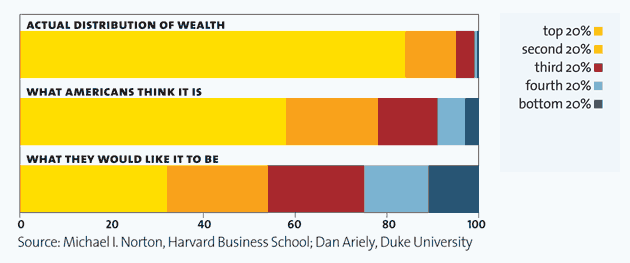
We are clearly a conservative, free-market, anti-redistributionist people, right?


Socialists!

Rarely do I pay attention public opinion polls—or give them much credence—because the perceptions of the population so rarely conform with reality.

I do, however, see the value in reading polls that highlight those misperceptions. And I like charts that give us a nice crystal clear picture of our national state of confusion.

The chart above reminded me of another one I remembered seeing about the public perception of the proportion of U.S. Foreign Aid within the Federal Budget. For good reason, too: it's almost the exact same chart:


Kinda makes you wonder what would happen if people actually started to pay attention to the fact that the country they live in bears little relation to the one that exists in their imagination (or on Fox).

Sunday, February 20, 2011

My God, What Have I Done?


With all the protests this week in Wisconsin, I've been thinking a bit about the role of unions in our culture. Certainly, there's the received view that is common today: that big, bloated unions stifled American industry and led to recessions and stagnation. And clearly there is at the very least a measure of truth to this.

But for various reasons (far too many to get into at the moment), I've found myself increasingly conscious of the value that unions brought toward establishing and maintaining the middle class. Perhaps nothing captures our shift from a union to non-union country better than the movement from defined pensions to 401(k)s.

The "individual investor" has been the image that has driven Reaganism in America and stands as the model upon which most of the middle class is suppose to be cast. But something happened on the way to that place:

The 401(k) generation is beginning to retire, and it isn't a pretty sight.

The retirement savings plans that many baby boomers thought would see them through old age are falling short in many cases.

The median household headed by a person aged 60 to 62 with a 401(k) account has less than one-quarter of what is needed in that account to maintain its standard of living in retirement, according to data compiled by the Federal Reserve and analyzed by the Center for Retirement Research at Boston College for The Wall Street Journal. Even counting Social Security and any pensions or other savings, most 401(k) participants appear to have insufficient savings. Data from other sources also show big gaps between savings and what people need, and the financial crisis has made things worse.


So, we ditched the unions for the magic of the market, believing them to be rational. But instead of security, we've seen the rich get much, much richer


That's overall share of wealth here, not income (which is still pretty badly slanted). Things haven't been this skewed since the turn of the LAST century. The time when the gap between the rich and everyone else was at its lowest also perfectly correlates with the era when unions were at their zenith in this country.

It's not hard to imagine ways that unions can be bad. It's not hard to come up with examples, either. But there was a reason, I think, why so many people fought and died to establish them. Unless the frame of the debate changes, this could be a long, dark time for the middle class.

Tuesday, February 01, 2011

Why, Exactly, Did They Have a Tea Party?


Lots of interesting commentary on yesterday's ruling by Judge Vinson, striking down the mandate and, then, the Affordable Care Act entirely.

I've been searching for good arguments in support of his ruling, but in the process, I came across this line of reasoning by Vinson. Take a look:

It is difficult to imagine that a nation which began, at least in part, as the result of opposition to a British mandate giving the East India Company a monopoly and imposing a nominal tax on all tea sold in America would have set out to create a government with the power to force people to buy tea in the first place.


It's hard to tell if this is conscious slight-of-hand or whether it really is more of a blind spot, but the really interesting thing about this statement, it's underlying logic and broad conclusion is just how much work is being done by the passive voice ("a mandate giving"; "imposing")—and how the agent in the passive voice ("who gave?") makes a HUGE difference in how you read this conclusion.

To wit: the objection of the Colonists wasn't to being taxed. It was who got to tax them:

The Tea Party was the culmination of a resistance movement throughout British America against the Tea Act, which had been passed by the British Parliament in 1773. Colonists objected to the Tea Act for a variety of reasons, especially because they believed that it violated their right to be taxed only by their own elected representatives
.

This comes up a lot, which is why I suspect it's an unconscious tick of a judge who is living in a contemporary conservative movement that abhors most taxes and has adopted the framework of the "Anti-tax Patriots" without seeming to bother considering their actual specific concerns in the first place.

The Founders had no problem with taxes. (The Constitution replaced the Articles of Confederation largely because the latter left the Federal Government ridiculously weak and unfunded.) In truth, the early U.S. government found all kinds of ways to get them, too, including regulating "inactivity." But that's a different argument.

The line isn't "No taxation!" It's "No Taxation Without Representation!" Perhaps the Founders would be appalled by the size and scope of today's government, but the Boston Tea Party isn't any kind of evidence of that.

There are several, shall we say, interesting lines of reasoning in this opinion. This one struck me as the the weakest, historically (not purely legally) speaking.

Wednesday, January 12, 2011

If Everyone Were Armed, Would We All Be Safer?


In the discussion about Gun Rights arguments that I conduct every semester, we pause to consider the oft repeated assertion that having more people armed will make us safer. To this debate then, I think this anecdote from Saturday serves as an instructive cautionary.

Joe Zamudio, a local in Tucson who grew up around guns his whole life, was in a nearby drug store and was armed when the shooting begin. Here's what happened next:

"I came out of that store, I clicked the safety off, and I was ready," he explained on Fox and Friends. "I had my hand on my gun. I had it in my jacket pocket here. And I came around the corner like this." Zamudio demonstrated how his shooting hand was wrapped around the weapon, poised to draw and fire. As he rounded the corner, he saw a man holding a gun. "And that's who I at first thought was the shooter," Zamudio recalled. "I told him to 'Drop it, drop it!' "

But the man with the gun wasn't the shooter. He had wrested the gun away from the shooter. "Had you shot that guy, it would have been a big, fat mess," the interviewer pointed out.


The idea that more guns will make us safer is heavily dependent upon anecdotes wherein gun possession is actually not, in fact, widespread and also dependent upon what I like to call the Hero Myth. The Hero Myth is a story we told about how all of these tragedies could have been averted if only you had a "well-armed" and "trained" person who could have shot the bad guy before he killed more innocents.

As Zamudio's example illustrates, though, there are many other possible scenarios that can follow from the introduction of more guns into an event. We had a similar situation here in Salt Lake a few years back, when an off-duty police officer helped hold down a killer at a local mall. We were very fortunate he was there. But even that story was made more problematic by the fact that the people who came out of the mall at the time claimed that there were TWO gunmen loose in the mall shooting at people.

In the real world, bad guys don't wear black hats. And, in fact, one of the arguments FOR laws that restrict firearms is that we know BEFORE someone begins shooting that they are the bad guys. (I'm not saying this is perfect method of doing this, but I'm rather surprised that most people who argue against gun laws fail to even recognize this as a fundamental purpose of having them in the first place, focusing instead on whether they prevent people from obtaining guns in the first place.)

And while I think there's a decent argument to be made that, knowing their victims are armed, many or most criminals would alter their behavior (though, one of those consequences might very well be to shoot first rather than threaten), a fair debate of this issue would require that we consider the full range of consequences of arming even "well-trained" non-professionals.

Zamudio is the kind of person you'd most hope would be around in a situation like this—and it still almost compounded the tragedy. What his example helps demonstrate is that there are no easy answers to gun violence.

Monday, December 13, 2010

Doctor! Doctor!

Lots to be said about today's ruling by a Virginia judge that the PPACA's Insurance Mandate is unconstitutional.

First, the insurance industry is going to be pissed.

Second, here's Ezra:

Hudson ruled against the government, but he didn't stop it (you can read the full opinion here). He refused the plaintiff's request for an injunction against the legislation's continued implementation. The construction of the bill's infrastructure will continue. And second, he refused to overrule anything but the individual mandate itself.

The real danger to health-care reform is not that the individual mandate will be struck down by the courts. That'd be a problem, but there are a variety of ways to restructure the individual mandate such that it doesn't penalize anyone for deciding not to do something (which is the core of the conservative's legal argument against the provision) [....] The danger is that, in striking down the individual mandate, the court would also strike down the rest of the bill. In fact, that's exactly what the plaintiff has asked Hudson to do.

Hudson pointedly refused.


And I find that more interesting than the fact that a dyed-in-the-wool conservative judge ruled in favor of the conservative argument du jour.

For those keeping score at home, that's 2 rulings that the law is constitutional versus 1 against. Once Florida gets its shot, I expect we'll have this thing all tied up.

Then it's off to the Supremes. And how will 5 "conservatives" and 4 "liberals" rule? Here's Jonathan Cohn:

Most court observers I know believe that at least one of the Republican appointees, most likely Anthony Kennedy, would agree with the government that the Affordable Care Act falls well within traditional boundaries of the taxing and interstate commerce powers. (For an example of such logic, see the Michigan ruling from a few weeks ago.)


For myself, I have shucked some legal idealism of late. I don't trust the courts to do anything but what they want to do. And given that the course is fairly reliably business friendly (even among the "liberal" members), I suspect the court will do whatever the industry ultimately wants it to do. Perhaps that will be overturning the whole law. Perhaps that will be using the mandate to open up new markets.

Today would be an especially odd day to stand by the idea of the courts as protector of deeply held legal principles, however.

Wednesday, November 24, 2010

Winning the War on Poverty

In a post today about why he was wrong to support Bush's really bad idea back in '05 to "save" Social Security by actually destroying it, Joe Klein manages to perpetuate another persistent myth, accepted without question on both the left and right.

I came to this belief the hard way, by overreading 30 years of experience as a journalist. Much of that time had been spent on urban issues, especially the failure of traditional liberal social programs to alleviate poverty. Indeed, welfare — Aid to Families with Dependent Children — as it was then constituted seemed a system of perverse rewards that intensified poverty, encouraging poor women not to marry, not to work, not to make sure their kids showed up at school and so forth. Their children were making and having babies prematurely, with no sense of responsibility. A discrete culture of poverty — in which people didn't look for work even when the economy surged — had taken hold.


To discuss the full issue of what's known generally as the "culture of poverty" is more than I have time or energy for right now. (For some thoughts on that topic, you can read here.)

What I want to specifically question is Klein's claim about "the failure of traditional social programs to alleviate poverty." Now, if by "alleviate" he means "eradicate," then, yes. Poverty is still here. That, however, would be a ridiculous way to formulate an argument. "Alleviate" is defined as "to make (pain, sorrow, etc.) easier to bear; lessen; relieve."

Still, it's true that most people view the War on Poverty as a failure, one that did little to help and maybe even made things worse.

That's clearly not true.


Or, rather, what happened with poverty doesn't prove this true. An actual causal argument would take more work. What's not a real mystery, though, is among which segment of the population the largest drop occurred.


People tend to overly focus on Welfare when they talk about the War on Poverty. But Medicare and (especially) Medicaid seem like the most likely cause of a sudden shift in senior poverty rates. (Or, wait! Maybe they all simultaneously won the lottery!)

The idea that the War on Poverty failed to "alleviate" poverty is not only wrong, it's diametrically opposed to what the evidence would seem to suggest. Poverty dramatically dropped, especially among groups directly targeted by the Great Society. Whether it simultaneously created a "culture of poverty" among the significantly fewer number of poor is a different question entirely (and one I think also poorly supported—but that's another argument for another time).

Sunday, November 14, 2010

Kitchen Table Budgeting


The New York Times has a handy interactive chart that grants us commoners the opportunity to try our hand at dealing with the Federal Deficit. Fun stuff!

When I gave it go, I found it relatively easy to fix the 2015 problem. Attacking the 2030 problem is a lot harder, but I'd also argue it's less important. We don't can't really predict that far into the future, and there are some "hard choices" we could make now that might seem more penny-wise/ pound foolish.

I'm sure there are any number of ways to slice this up and your mileage may vary. At any rate, here's what I'd do, along with their explanations of what it means and some of my reasoning (ignoring politics, for the moment):


MILITARY
x Reduce nuclear arsenal and space spending
Would reduce number of nuclear warheads to 1,050, from 1,968. Would also reduce the number of Minuteman missiles and funding for nuclear research and development, missile development and space-based missile defense.

x Reduce military to pre-Iraq War size and further reduce troops in Asia and Europe
“This option,” according to the bipartisan Sustainable Defense Task Force, “would cap routine U.S. military presence in Europe and Asia at 100,000 personnel, which is 26 percent below the current level and 33 percent below the level planned for the future. All told, 50,000 personnel would be withdrawn.” The option would also reduce the standing size of the military as the wars in Iraq and Afghanistan wind down.

x Reduce Navy and Air Force fleets
Under this option, the Navy would build 48 fewer ships and retire 37 more ships than now scheduled. Overall, the battle fleet would shrink to 230 ships, from 286. In addition, the Air Force would retire two tactical fighter wings and reduce the number of fighter jets it planned to purchase.

x Cancel or delay some weapons programs
This option would cancel the purchase of some expensive equipment, like the F35 fighter jet and MV-22 Osprey, with less expensive equipment that the bipartisan Sustainable Defense Task Force judged to have similar capability. It would delay other purchases. Research and development spending, which the task force considered a relic of the cold war arms race, would be reduced.

x Reduce the number of troops in Iraq and Afghanistan to 60,000 by 2015
Today, the United States military has 100,000 troops in Afghanistan and 50,000 in Iraq. The Obama Administration plans to reduce these numbers in coming years but has not specified troop levels. Defense and budget experts say this 60,000 option would be faster than what is now planned. The savings is the difference between the administration's projected spending and the


I've seen a lot of military analysts make most of these arguments (and in one compelling case, calling for the elimination of the Air Force entirely). I won't say I like the broad strokes used here, but there's a good argument to be made for each. I'm not slashing here for pacifist reasons. There just doesn't seem to be a strong economic or military reason for most of these.

I rejected "Reduce noncombat military compensation and overhead," though I think there's something to be said for the part about reducing "the length and frequency of combat tours. No unit or person will be sent to a combat zone for longer than a year, and they will not be sent back involuntarily without spending at least two years at home."

I also rejected "Reduce the number of troops in Iraq and Afghanistan to 30,000 by 2013." This may be a good idea, but in the interests of logistics and unpredictability, I went for the more moderate proposal.

HEALTH CARE
x Reduce the tax break for employer-provided health insurance
This option would reduce the tax break for employer-provided health insurance, by slowly adjusting the cap, so that it increases at the rate of economic growth, rather than the growth in health costs – which tends to be significantly faster. Over time, more employer spending on health insurance would be taxed.


The employer tax break is such a terrible idea and it's one of the significant factors contributing to rising health care costs. I'm wary of "malpractice reform," in large part because I'm opposed to arbitrarily limiting the ability of the victims to receive just compensation. There are many other ways of addressing this, some of which make a lot more sense.

MODIFYING ESTATE TAXES:

x President Obama's proposal
President Obama's proposal is more agressive than Kyl-Lincoln, but would still cut the estate tax when compared to the Clinton years. The Obama plan would exempt the first $3.5 million from any taxable estate. Any estate above $3.5 million would be taxed at a 45 percent rate. These are the same provisions that applied in 2009, as part of the 2001 Bush tax cut.

INVESTMENT TAXES:
x President Obama's proposal
Capital gains and dividends are now untaxed for couples with incomes below $68,000. For everyone else, the tax rate is 15 percent. This option, proposed by President Obama, would raise the rate to 20 percent for households making roughly $250,000 a year and above.

THE BUSH TAX CUTS
x Allow expiration for income above $250,000 a year
This option would allow the expiration, on Jan. 1, of the Bush tax cuts for the top 2 percent or so of households on the income distribution – those making $250,000 or more. On average, the change would equal about 2 percent of a given household’s pretax income.


If I were being more responsibly, I'd probably void the tax cuts for everyone under $250,000, too. But there's definitely an argument against doing so in a recession (whereas there's practically no good argument against doing on those making over $250,000).

NEW TAXES AND TAX REFORM

x Millionaire's tax on income above $1 million
Currently, the top tax brackets starts at about $375,000. In past decades, it started at much higher income level, after inflation is taken into account. This option – which the House passed last year but the Senate did not – would create a new 5.4 percent surtax on income above $1 million.


We should probably have more tax brackets. It's ridiculous that you treat someone who makes $1 million the same as someone who makes less than half of that.

CLOSING TAX LOOPHOLES:

x Eliminate loopholes, but keep taxes slightly higher
The deficit commission proposed a series of tax overhaul plans. Each one would reduce tax breaks for companies and individuals, while lowering tax rates. On the whole, the plans would raise revenue. One plan would cut all tax breaks other than the child and earned-income tax credits and those for mortgages, health and retirement benefits. This option is the same as that one – except that tax rates would be cut less, raising more revenue to reduce the deficit.


I'd like to reduce tax rates as well, but, again, you know, that fiscal responsibility thing.

x Reduce mortgage-interest deduction by converting to credit
The benefits of the mortgage-interest deduction (and several other tax breaks) flow mostly to high-income households – because they tend to have larger mortgages and have marginal income-tax rates. This option would reduce the value of some of those breaks to high-income households.


This current tax break is very nice for me, but it's not very good policy and probably should go.


x Carbon tax
This option would tax carbon emissions, starting at $23 per ton of CO2. The tax rate would increase at a constant annual rate of 5.8 percent, from 2012 through 2050.


This is one of those nice policies that 1) be fiscally responsible and 2) actually do some good by somewhat changing behavior in a more sustainable direction. The economic impact, according to neutral observers, should be small.


x Bank Tax
This option would tax banks based on the size of their holdings and the perceived riskiness of those holdings. Larger, riskier banks would pay more tax, both to discourage them from taking big risks and to help cover the costs of future financial crises.


Like the Carbon Tax, this one is something I'd recommend doing even if it cost the government money. The value of financial services to the overall economy is negliable and the dangers associated with overly large institutions with too much risk simply not worth it.

Doing just these things gets me to a $170 billion surplus in 2015 and up to $1,257 billion ($100 billion short) toward balancing the budget in 2030. I'm not as concerned about trying to reach perfection with the 2030 number for a variety of reasons, but simply removing those tax cuts on those under $250,000 a year would more than make that up and allow us to start paying down the debt.

A note on what I didn't touch:


* The Social Security and Medicare options include a lot of red herrings. We could raise the retirement and eligibility ages, but the people most likely to be hurt by that are the poor and blue collar workers. I'm against means testing because this is social insurance not a welfare program and should remain as such. Indexing to inflation will likely mean a real drop in income. Why there's no talk of a slight tax increase on workers now, though, I don't understand. But at any rate, Social Security may not need any of these changes—and it's not cheaper to deal with them now—so I don't see the point.

* I could be fine with eliminating farm subsidies, though I'd rather they just be shifted to foods that are healthier than corn. If we're going to prop up our agricultural industry, it should at least not be making us sick in the process.

* Foreign aid is useful and cheap, so this is silly.

* So are many earmarks.

* Random reductions in the Federal workforce are just arbitrary and ridiculous, as is deciding that you aren't going to pay them.

* Aid to states is one of the few things that has kept us out a recession.

* What, exactly would be the point in cutting funding to National Parks and Museums? These are popular and used public services. Silly.


Now... go knock yourselves out.

Tuesday, November 02, 2010

IOKIYAR, Part MMXVIII

So...after a Presidential year election, when more people voted than ever in history, giving Democrats the largest majority of any party in a generation, Republicans filibustered and opposed everything the Democrats proposed, even conservative ideas.

Now, in an off-year election, with Republicans hyper-motivated, (even as their preferences do not represent the majority opinion of even all registered voter), GOP leaders insist Democrats "respect the will of the voters."

I guess this is what Boehner means by bringing "humility" to the House.

Somehow, I don't see the Democrats reciprocating with the same type of honor and respect they were afforded. Unfortunately.

Tuesday, September 21, 2010

Don't Need A Weatherman...


One of my pet peeves comes any time we have a cold snap or unusually cold weather, a climate change denier will pipe up with a snarky comment that this somehow clearly disproves the theory.

Actually, it's not that comment that is my pet peeve. It's what happens when you point out that unusually cold weather is entirely consistent with current models of climate change.

"Well, you just want it both ways. Warmer temperatures, you say, prove that the climate is warming and cold temperatures don't disprove it. You're just taking anything as evidence of global warming."


Um, no.

Global temperature increases are just that—global. And we measure those with lots and lots and lots of data. So, scientists conclude that 2009, for example, was one of the warmest years on record, and the warming trend has been clearly moving upward for a long while now.

Thus, when someone says, "It's a record cold here," that in no way serves as a refutation of arguments about global climate change. And, in fact, one of the things scientists are increasing beginning to understand is how a greater overall temperature is most likely lead to unusually cold spells in parts of the world. They reach that conclusions by doing studies.

But just in case it needs to be stated more directly: THIS IS NOT CONCLUSIVE PROOF OF GLOBAL WARMING.

There. I said it.

However, the more evidence that fits the theory (and the less variation of evidence away from it) means that an argument becomes stronger, not weaker.

That so many seem not to understand this relatively simple point drives me more than a little crazy.

** Update **
(In response to Al, below—because this was too long to leave in comments.)

Al wrote:
I don't even trust my own statistics. Generally, the goals of statistic takers show much more correlation to the results than the actual data taken. If you look at Financial Statements for all publicly traded companies, there is a section called MDA, Management's Discussion & Analysys. Just look at past MDA for AIG, GM, Chrysler, Enron, TYCO, etc. They will have plenty of statistics in the MDA that show how and why they will be successful. All of the statistics are audited, and are in fact (usually) correct - it is just that, as it turns out, even though the statistics they use might have a correlation to the financial results, there are plenty of other factors that are unmentioned that have far more to do with it.


Okay, but then here's my question: how do you reach the conclusion that these "other factors" have "far more to do with it"?

Sticking just with your example, the assertion is that these publicly traded companies are demonstrating correlation and assuming causation, despite the fact that there are other factors that, as you say, aren't merely just as likely, but more likely. (I just covered correlation and inductive logic in my students last week, so this is a little bit in my wheelhouse.)

Fair enough. I have no idea whether that statement is true or even why it's likely true. Why would these companies present as true something that is so weak? (Are they fudging facts because it makes them look better and they think they can get something by the auditor?) Are you saying that it is so obvious that the other factors are more important that we don't need to even make much of an argument? Are the actual causes just too complex and unknowable for them to say this with certainty (and, if so, how can we say that these other causes "have far more to do with it"?

Partly, though, I wonder if your skepticism is the result of a misunderstanding about the peer review process. (That's extremely common. I discuss it with my students, but most still struggle with it.) If the companies in this analogy are the researchers and the data is their research, you seem to be saying that auditors may check the factual truth of their claims and determine that they are true, yet there's just not enough to make a clear inductive leap to the strong conclusion that this company will be successful.

But that analogy is a little apples to oranges and needs tweaking. If the researchers are the companies and the research is their MDA, the auditors in this case would be other climate change experts in the peer review process who are used by the journals to evaluate the veracity of the work that's submitted.

This all happens before a paper can even be published. So the papers we're discussing are the "post-audited" work, which would be required to be corrected once these kinds of basic logical errors are found before it can be published.

But even so, these papers could still be wrong, even if they increase correlation significantly. That's why single papers are useful but not definitive. So rather than talk about one paper or bit of research as if either themselves prove something, it's better to look at many, many different papers, by different researchers, conducting independent investigations, at different journals, with different reviewers. And all of those papers have the option to produce exactly contrary arguments for very different conclusions, going through the same process.

So, the proper analogy would be as if AIG presented a report to an auditor, with its claims of why it would be successful, which the auditor reads, identifies logical fallacies, requires corrections in order to remove faulty claims, and then that revision with its data is published for every other company and auditor to look at. Then other people publish competing reports, over a number of years, all of which must also show their data. Then, periodically, all the auditors get together every few years and try to come up with what they think is the most likely reasons for AIG's success.

And THAT'S the consensus that people are currently denying with climate change. As I said above, it's not that that consensus couldn't still be wrong in some way—but the direction of the correlation has pretty much all been moving in the direction of confirming two broad theses: current global warming trends are unprecedented and man appears to be the cause.

A theory is much strong than a fact, my scientist friends like to say. And that makes sense because a theory is what we develop to explain many facts. But as we learn more facts, theories evolve, and the more we know, the less dramatically that theory changes over time. That's why these trend lines are important.

As I said, it's not that I think this theory has to be correct. But it's really not even debatable anymore what the science is showing us about warming trends and human activity. Yet this is precisely what people think is in question and deny.

Friday, August 27, 2010

Kids (A Primer)

Daycare Boy #1: I wish I was Spiderman!

Daycare Boy #2: I wish I was the Incredible Hulk!

Daycare Boy #3: I wish I was a girl!

(Pregnant silence)

Daycare Boy #3 (undeterred): Then I could kiss some Conner!

Thursday, August 12, 2010

Life of Writing


"I would never want to belong to any club that would have me as a member." - Woody Allen

Perhaps it's the advent of the school year that has writers who teach thinking about our struggles with writing. When I read Lynn's post here, I felt those familiar pangs, and in fact I'd been having them for a few weeks myself.

"Life intercedes" is how I've thought of my own struggles with balancing writing, teaching, parenting, household, and play. Writing is the only one of these that likes to hide in a corner and shout at you (surprisingly, my daughter does not). M and I had a long talk about priorities last night, which was good, but also brought up all kinds of frustrations (for both of us) and insecurities (mostly me). Nik's suggestion about writing for 15 minutes is good (though I'll most likely follow Lynn's path of 500 words a day since I tend to filibuster timed sessions).

But this is all very hard, in large part because of the insecurities and uncertainties about what I'm doing, whether it's any good, whether it will find an audience, etc. The questions that Mary Anne talks about in this post have been on my mind a lot, and my accomplishments are far less than either she or Lynn can point back to and take comfort in. There's a solace to be found in our success, but we all also seem more than willing to tear those down and discard them.

Mary Anne gets to the heart of the problem when she notes there are all kinds of different ways to write—and costs associated with all of it. But still, I think Middlebrow sums it up best: "Just f@#$ing relax and write when you want to write. Don't stress out about it."

(I definitely made up the F@#$ing part. But I think it was clearly implied.)

Monday, August 09, 2010

Fear of an Islamic Planet

In a sane world, this should surprise no one.

A two-year study by a group of academics on American Muslims and terrorism concluded that contemporary mosques are actually a deterrent to the spread of militant Islam and terrorism. The study was conducted by professors with Duke’s Sanford School of Public Policy and the University of North Carolina. It disclosed that many mosque leaders had put significant effort into countering extremism by building youth programs, sponsoring antiviolence forums and scrutinizing teachers and texts.

Radicalization of alienated Muslim youths is a real threat, Mr. Bagby said. “But the youth we worry about,” he said, “are not the youth that come to the mosque.”


There's something of a cottage industry for the idea that "Muslims are Evil!" In fact, dozens of books out there seek to prove that Islam isn't a religion but a cult, that its followers are programmed to hate the West and anyone who isn't them, that murder and jihad are part of their DNA. I've read through some of these, and they are scary places to live.

All of which makes it difficult to explain to people that this is pretty much a con, sold by people preying off of their' fear and understandable ignorance. These people writing these books aren't serious scholars or respected experts—or, rather, what they're producing isn't serious scholarship. When no one is checking your work, you can make up any old thing you like or cherry pick snippets from archaic texts to support your point or identify radicals who inflame violent passions in their followers in the name of that religion and claim it represents the religion as a whole.

Or, as David Boies put it recently, when discussing the failure of Prop 8 proponents to win with the arguments on the merits:

"Well, it's easy to sit around and debate and throw around opinions appear-- appeal to people's fear and prejudice, cite studies that either don't exist or don't say what you say they do. In a court of law you've got to come in and you've got to support those opinions. You've got to stand up under oath and cross-examination. And what we saw at trial is that it's very easy [...] to make all sorts of statements and campaign literature or in debates where they can't be crossexamined.

"But when they come into court and they have to support those opinions and they have to defend those opinions under oath and cross-examination, those opinions just melt away. And that's what happened here. There simply wasn't any evidence. There weren't any of those studies. There weren't any empirical studies. That's just made up. That's junk science."


And the same goes for peer review, where you must submit your claims to scrutiny, to prove your case. Academics have all kinds of disagreements. But arguments that are unsupported and intellectually dishonest do not get taken seriously.

And what we know is that al-Qaeda and their lot exploit their followers' ignorance about Islam. These terrorists aren't representative of anything except the ability of con artists to manipulate the resentments of the gullible into justifications for the unjustifiable and, yes, evil.

Which isn't to say that there aren't crazy Islamic (and Christian) leaders out there ginning up resentment and hatred into a froth of violence. But for those who have led themselves to believe that many or most (or even a significant number of) Muslims are pro-violence, the point is not only that that doesn't reflect a serious study of the religion or its followers—it also defies common sense

Were it the case that Islam was anything like these con artists claim it to be, we'd be overrun already. Instead, American muslims are some of the most content and least radicalized in the world. If anything, the record of inclusion and acceptance of Muslims in our country is a significant contributor to their non-radicalization. (And in other countries that are far less accepting, the opposite appears to be happening.)

Cases like that of Faisal Shahzad, the Times Square bomber, prove this more than anything else. His lack of connection to the local Muslim community and his complete inability to count on that community for assistance pretty overwhelmingly demonstrates this fact, as do the other uncoordinated and bumbling "home grown" terrorists that have popped up.

All of which is another reminder of why this "controversy" is not only stupid, but also counterproductive and potentially dangerous. And this study is just another confirmation that people who try to pretend that Islam itself is the problem have it exactly backwards.

Saturday, August 07, 2010

Taxing the Rich

We can all debate how best to deal with the long-term budget situation. But as the Wall Street Journal lays out here pretty nicely, Obama's plan lets tax cuts expire for the very rich and leaves them for those making under $250,000.


The strange thing, of course, is that we get endless "tea party" rantings, furious over Obama's policies, believing that they have blown up the deficit and made our long term fiscal problems worse when they haven't.

I actually take Obama to task for promising to not raise taxes on those making more than $250,000 a year, and for those who are truly deficit hawks, I think you are on solid ground to note that letting all of these cuts expire would probably help balance that account. And I think you could also argue that we should keep these taxes low to as to boost consuming. That's an interesting discussion.

And there are still those who would probably still try to say that we'll end up paying the consequences of his policies later, which is fine. We can debate those arguments, such as they are, another time. (And I have.)

But as the infamously liberal Wall Street Journal shows, it's just wrong to say that Obama isn't offering a tax plan that benefits most taxpayers.