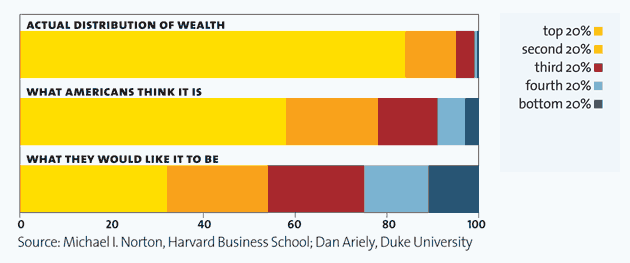
We are clearly a conservative, free-market, anti-redistributionist people, right?
Socialists!
Rarely do I pay attention public opinion polls—or give them much credence—because the perceptions of the population so rarely conform with reality.
I do, however, see the value in reading polls that highlight those misperceptions. And I like charts that give us a nice crystal clear picture of our national state of confusion.
The chart above reminded me of another one I remembered seeing about the public perception of the proportion of U.S. Foreign Aid within the Federal Budget. For good reason, too: it's almost the exact same chart:
Kinda makes you wonder what would happen if people actually started to pay attention to the fact that the country they live in bears little relation to the one that exists in their imagination (or on Fox).
With all the protests this week in Wisconsin, I've been thinking a bit about the role of unions in our culture. Certainly, there's the received view that is common today: that big, bloated unions stifled American industry and led to recessions and stagnation. And clearly there is at the very least a measure of truth to this.
But for various reasons (far too many to get into at the moment), I've found myself increasingly conscious of the value that unions brought toward establishing and maintaining the middle class. Perhaps nothing captures our shift from a union to non-union country better than the movement from defined pensions to 401(k)s.
The "individual investor" has been the image that has driven Reaganism in America and stands as the model upon which most of the middle class is suppose to be cast. But something happened on the way to that place:
The 401(k) generation is beginning to retire, and it isn't a pretty sight.
The retirement savings plans that many baby boomers thought would see them through old age are falling short in many cases.
The median household headed by a person aged 60 to 62 with a 401(k) account has less than one-quarter of what is needed in that account to maintain its standard of living in retirement, according to data compiled by the Federal Reserve and analyzed by the Center for Retirement Research at Boston College for The Wall Street Journal. Even counting Social Security and any pensions or other savings, most 401(k) participants appear to have insufficient savings. Data from other sources also show big gaps between savings and what people need, and the financial crisis has made things worse.
So, we ditched the unions for the magic of the market, believing them to be rational. But instead of security, we've seen the rich get much, much richer
That's overall share of wealth here, not income (which is still pretty badly slanted). Things haven't been this skewed since the turn of the LAST century. The time when the gap between the rich and everyone else was at its lowest also perfectly correlates with the era when unions were at their zenith in this country.
It's not hard to imagine ways that unions can be bad. It's not hard to come up with examples, either. But there was a reason, I think, why so many people fought and died to establish them. Unless the frame of the debate changes, this could be a long, dark time for the middle class.